
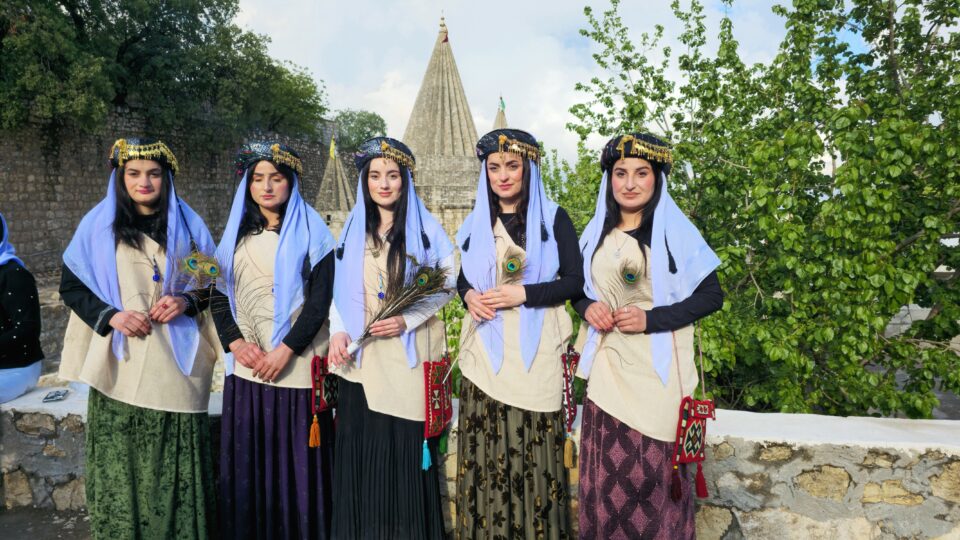
Sema
Marriage and Wedding Ceremonies among the Ezidis
Marriage is considered one of the religious obligations among Ezidis, and an Ezidi is only permitted to marry within their own social class. There are also specific customs and traditions associated with marriage among the Ezidis.
When the groom chooses a suitable bride, he formally proposes to her. Traditionally, engagement arrangements were the responsibility of the parents or their representatives, together with their Sheikh or Pir. Before the wedding, the groom also selects one of his friends from a different social class to become his “Brother for the Afterlife,” while the bride chooses a “Sister for the Afterlife” who accompanies her to her husband’s home.
Following this, the wedding ceremonies and celebrations are held. The bride is not allowed to leave the house until one week after the wedding.
The dowry may be determined by the Ezidi Supreme Spiritual Council. On August 14, 2009, the Supreme Ezidi Spiritual Council held an expanded meeting attended by its advisory board and representatives from Ezidi regions. After consulting those present regarding the dowry amount for Ezidi women, several decisions were made, including:
- The bride’s dowry would be fixed at 75 grams of 21-carat gold, whether inside or outside Iraq.
- Distribution of the dowry would be the responsibility of the bride’s guardian, while taking the bride’s rights into consideration.
- Marriage through exchange arrangements (Qisa bi Qisa – bride exchange) would be prohibited.
After completing the engagement ceremonies, the groom and his family prepare for the wedding celebration by purchasing all necessary items, including gold for the bride and gifts for friends and relatives. Wedding invitations are then distributed among the village residents.
On the Henna Night, a small celebration is held for the groom’s relatives and friends. The following morning, the groom and the wedding participants travel in a decorated car to the bride’s house and then to the wedding venue.
The bride then breaks a clay jar containing sweets and money at the door of her room, symbolizing the opening of a new chapter as she enters her new family. Afterwards, the groom and his brothers visit the Sheikh’s house, where prayers and blessings are offered to solemnize the marriage.
Seven days after the wedding celebration, a special meal is prepared consisting of broad beans (fava beans), chickpeas, and wheat grains. Young women also invite relatives, friends, and neighbors to a small gathering where the bride goes, accompanied by songs and clapping, to a water container holding drinking water.
She is given a needle and thread and strings together broad beans, chickpeas, and wheat grains before placing them into the water container. She then pours one bowl of the water onto the ground and sprinkles another over the heads of those attending the celebration.
Finally, the bride throws a scarf behind her while a group of unmarried girls stand waiting. Whoever catches the scarf is believed to have good fortune and is thought to be likely to marry soon.
Afterwards, the bride visits her parents’ home, and the wedding ceremonies come to an end.
Source: “The Ezidis in the Kurdistan Region and a Study of Their Social and Cultural Conditions”, a Master’s thesis by Sulaiman Sabri Sulaiman.