
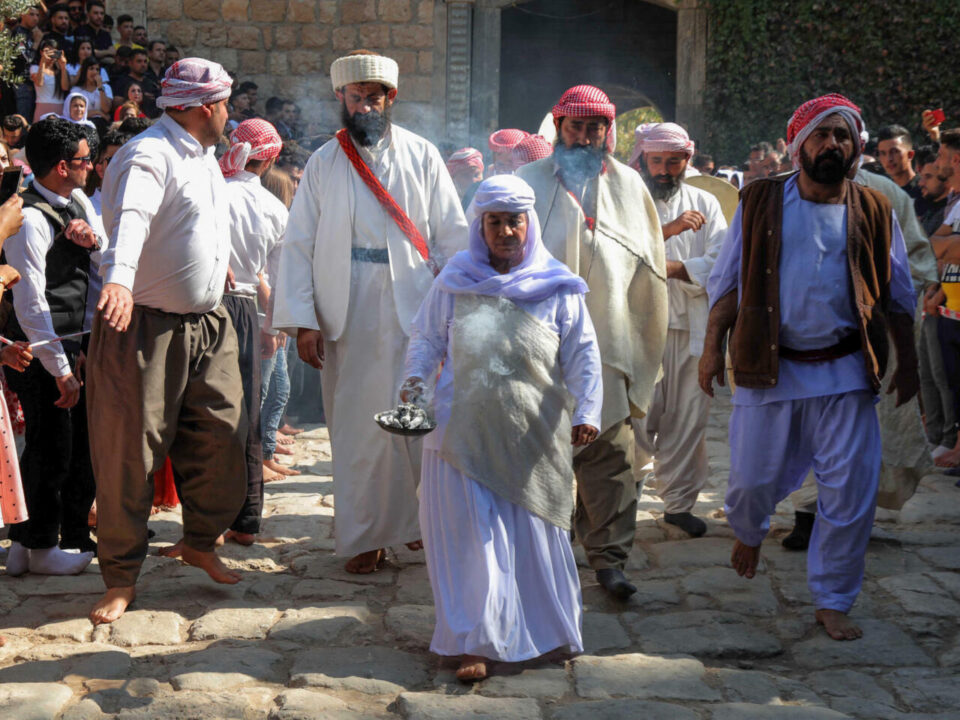
Sema
1. God and the Seven Angels
Ezidis believe in one God, the Creator of the universe and everything within it, including the sun, moon, earth, sky, day and night, angels, paradise, hell, and all living beings.
They also believe in Seven Holy Angels, who were created by God from His divine light. According to Ezidi religious teachings, these angels were the first of God’s creations and serve under His command, carrying out His will and conveying divine messages to humanity. Their names are:
- Azrail
- Jibra’il
- Mika’il
- Darda’il
- Shamqa’il
- Nura’il
- Israfil
2. Earth, Water, Fire, and Air
Ezidis believe that God created Adam from the four natural elements: earth, water, fire, and air. Because of this belief, these elements are regarded as sacred and are often invoked in oaths.
Among them, fire holds a particularly special status. Sacred flames are traditionally kept burning in Ezidi shrines and places of worship as a symbol of holiness and divine light.
3. Prophets, Messengers, Saints, and Righteous Figures
Prophets, messengers, saints, and righteous individuals occupy a revered place in the Ezidi faith. Ezidis believe that all prophets and messengers were sent by God and make no distinction between them.
Many Ezidi families name their children after prophets, and Ezidi religious hymns and oral traditions contain stories about figures such as Prophet Muhammad, Abraham (Ibrahim), Ishmael (Ismail), Jesus (Isa), and Job (Ayyub), peace be upon them all.
4. The Sacred Barat
What is the Barat?
The Barat is a small sacred sphere, approximately the size of a hazelnut, made from the holy soil of the Barat Cave within the Sacred Lalish Temple.
According to Ezidi belief, Lalish—including its soil, water, and trees—is the spiritual “yeast” or origin of the earth. The Barat is therefore made from Lalish’s sacred soil, mixed with water from the White Spring (Kaniya Spî) and salt, making it one of the holiest objects in the Ezidi religion.
How the Barat is Made
The preparation of the Barat follows a sacred ritual:
- Virgin girls and the caretakers of Lalish collect the holy soil using special spoons.
- The soil is carefully sifted until it becomes fine.
- It is mixed with water from the White Spring.
- Throughout the process, Ezidi clergy and Qewwals (religious hymn chanters) perform sacred hymns accompanied by the daf (tambourine) and shibab (flute).
- The ceremony continues until dawn.
After completion, the Barat is distributed to worshippers and pilgrims visiting Lalish as a sacred blessing.
The Barat in Ezidi Homes
When the head of an Ezidi household makes his first pilgrimage to Lalish, he is expected to bring a Barat home. For this reason, nearly every Ezidi home traditionally contains a Baghja—a small cloth pouch hung on a wall specifically to preserve the sacred Barat.
The Baghja is considered a personal family possession and is not exchanged between husband and wife, as doing so traditionally symbolizes separation or divorce.
The Barat is also distributed during the ceremonial tours of the Sanjaq through Ezidi communities.
Source: Adapted from The Ezidis in the Kurdistan Region of Iraq: A Study of Their Social and Cultural Conditions (2003) by Sabri Suleiman Sabri.