
Sema
The receding waters of the Mosul Dam have uncovered the submerged village of Old Khanke, revealing a martyr’s grave from 1961 along with the remarkable discovery of an ancient city and a Hellenistic-era cemetery.
The lowering waters of the Mosul Dam have revealed a moving overlap of modern and ancient history: the reemergence of the submerged village of Old Khanke, with the grave of a local martyr, and the discovery of a major archaeological site thousands of years old.
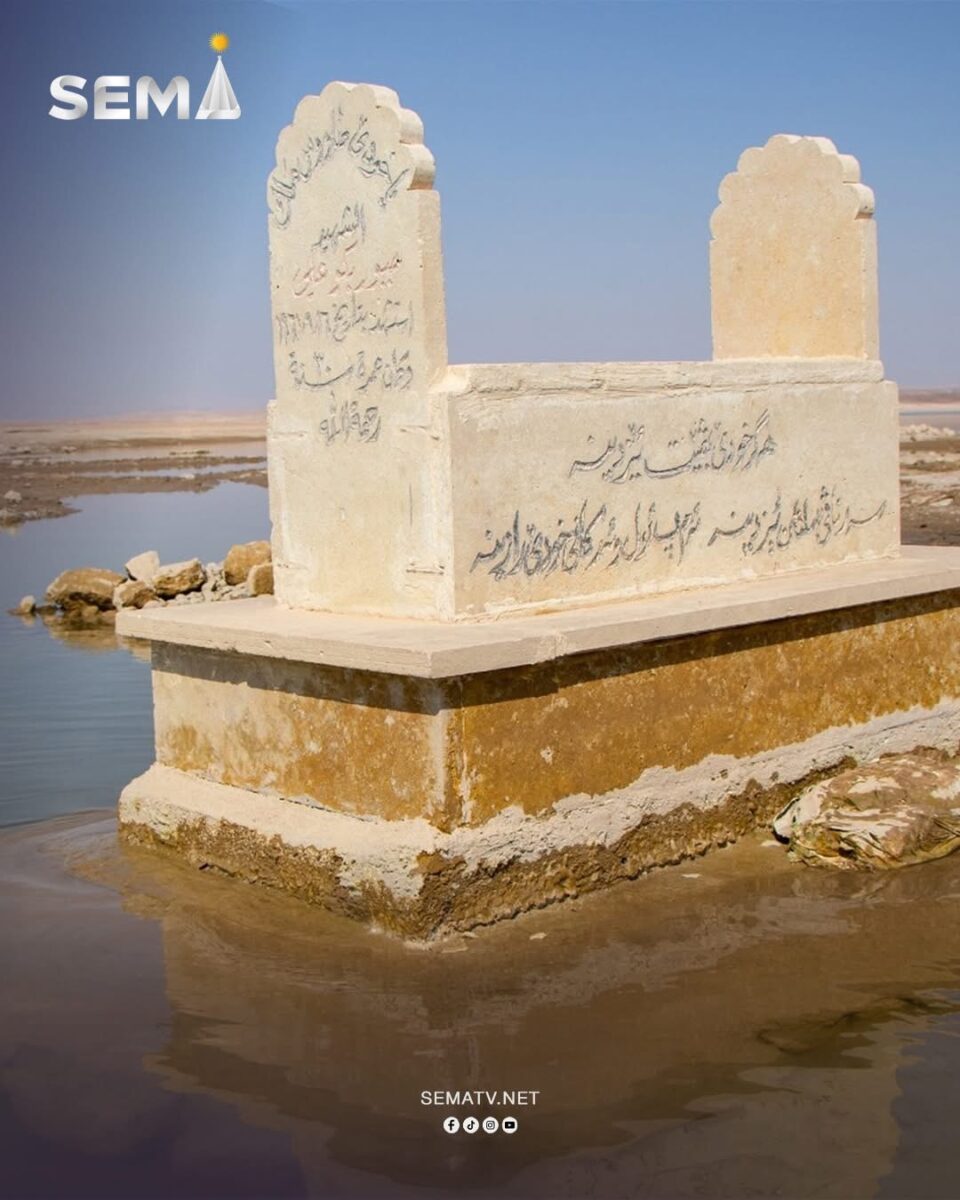
As the waters receded, former villagers returned to the exposed land to revisit childhood memories and honor the grave of Juboor Beko Ali, who was martyred in 1961 during an assault by the Iraqi regime. His resting place, long hidden beneath the lake, has once again become a symbol of the village, which once housed more than 200 families before its submersion.
Residents recalled that this is the third time the martyr’s grave has surfaced. “This is Juboor Beko Ali,” one said. “When the water rises, it disappears; when it drops, it reappears.” For the community of Khanke, the site remains a place of remembrance.
The reappearance has stirred memories of the violent attack that led to the village’s decline. One elder, who was seven years old at the time, described how two airplanes bombarded the village, strafing it with machine guns and rockets, before ground forces attacked. “The battle lasted seven days. On the first day, Juboor Beko Ali was martyred. They took his body, along with hundreds of our livestock, before leaving,” he recalled.
Though the dam’s low waters pose challenges, they have also offered a chance for the community to reconnect with its history and landmarks, where a defining struggle took place 64 years ago.
At the same time, the Directorate of Antiquities and Heritage in Duhok confirmed that the water’s retreat has unveiled an extraordinary archaeological site. Director Bekas Brifkani announced the unearthing of “a city inhabited more than five thousand years ago, along with the largest known cemetery of clay coffins from the Hellenistic period (around 300 B.C.).”
While the site was first identified in 2023, this year’s drastic drop in water levels allowed excavations to begin. Brifkani noted that 40 graves have been uncovered, with artifacts being carefully separated and prepared for transfer to the Duhok National Museum.
He emphasized that the work is being carried out entirely by local archaeologists with the support of the governorate. The graves and ancient city were found in the area of Old Khanke, overlooking the Mosul Dam lake in Duhok province.