
Sema
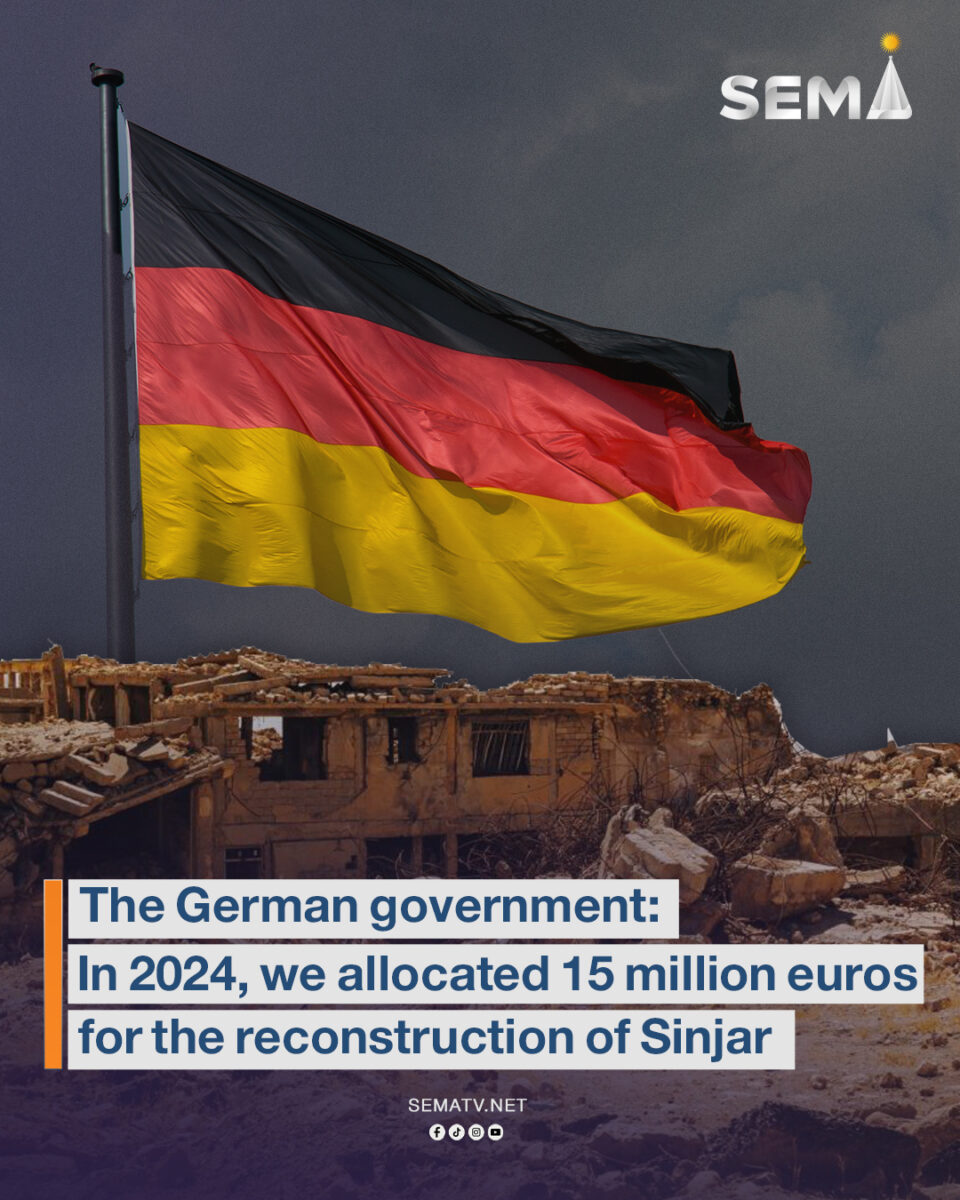
Germany has allocated €15 million (approximately $17.5 million) in 2024 to support reconstruction efforts in Shingal (Sinjar)—the historical homeland of the Ezidi people—aiming to facilitate the return and reintegration of displaced Ezidis, according to a statement from the German Federal Ministry for Economic Cooperation and Development (BMZ) on Sunday.
In an email to the media, a BMZ spokesperson confirmed that Germany has invested over €2 billion (around $2.34 billion) in Iraq’s reconstruction since 2014, underlining Berlin’s long-term support in rebuilding war-affected communities.
The spokesperson highlighted Germany’s key role in assisting nearly five million internally displaced persons (IDPs) to return home after the devastation caused by the rise of the so-called Islamic State (ISIS) in Iraq.
Currently, Germany is financing 11 ongoing projects in Shingal, totaling around €15 million, which focus on reconstruction, psychosocial support, and agricultural development, all crucial to restoring life in the war-ravaged Ezidi region.
“Support for reconstruction in Ezidi areas will continue,” the ministry representative affirmed.
ISIS captured vast areas of northern and western Iraq in June 2014, and by August launched a brutal campaign in Shingal. During the massacre, it is estimated that between 5,000 and 10,000 Ezidi men and elderly women were killed, while 6,000 to 7,000 Ezidi women and girls were abducted for sexual slavery and human trafficking. Nearly 400,000 Ezidis were forced to flee, with most taking refuge in the Kurdistan Region.
The United Nations has officially recognized these crimes against the Ezidis as genocide.
Although Iraq declared victory over ISIS in 2017, approximately 21,000 Ezidi families are still living in displacement camps, mainly in the Duhok province of the Kurdistan Region. Their return to Shingal remains obstructed due to ongoing security challenges and the presence of armed groups in the area.
In a separate statement to Rudaw on Thursday, the German Foreign Ministry reported that between 2014 and 2022, Germany provided €800 million ($933 million) in humanitarian aid and an additional €2.6 billion ($3 billion) for stabilization in the aftermath of the ISIS conflict.
With the situation in Iraq now considered “improved,” Germany has phased out emergency aid but remains a strategic partner to both the Iraqi government and the Kurdistan Region. Berlin has pledged continued collaboration in economic development, energy, and civil society initiatives.
Germany is also supporting Iraq’s efforts to address climate change, recognizing it as an emerging national challenge. “We are helping Iraq adapt to the impacts of climate change,” the ministry stated.
Key German institutions—such as the German Society for International Cooperation (GIZ), the German Development Bank (KfW), and various civil and religious organizations—will maintain their presence and operations in Iraq.
Germany’s current strategy involves shifting from emergency response to long-term sustainable development, with a focus on gradually transferring responsibility to local Iraqi actors, the ministry concluded.