
Sema
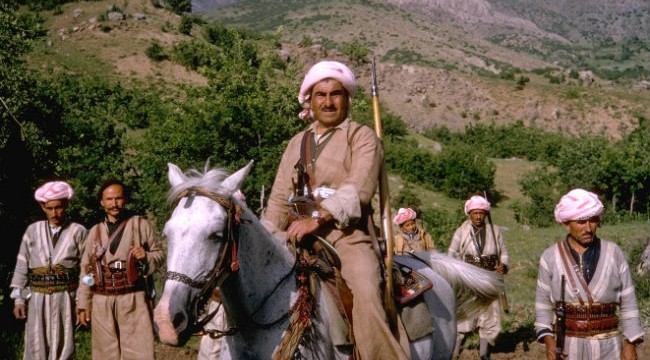
Today, Sunday, March 1, 2026, marks the 47th anniversary of the passing of the leader of the Kurdish liberation movement and the spiritual father of the Kurdish people, Mullah Mustafa Barzani.
Mullah Mustafa Sheikh Muhammad Barzani was born on March 14, 1904, in the village of Barzan in Kurdistan. At the age of three, he was imprisoned along with his mother for nine months during an Ottoman campaign, following the arrest of his elder brother, Abd al-Salam.
Mullah Mustafa Barzani belonged to a religious family that followed the Naqshbandi order. He participated in Sheikh Mahmoud al-Hafid’s 1919 uprising and was entrusted with leading a force of 300 fighters. He was later sent by Sheikh Ahmed Barzani to Sheikh Said Piran in Northern Kurdistan (Kurdistan-Turkey) to coordinate with the ongoing revolution.
During the Kurdish uprisings of 1931–1932, he led a large force to defend the Merxur–Shirwan axes against the British, gaining recognition as a skilled and experienced military commander.
During World War II, Mullah Mustafa Barzani led an armed uprising in the Barzan area. At that time, the Peshmerga numbered around 2,500 fighters, which caused the Iraqi government to lose control over the region. After a year and a half, however, the Iraqi government gathered a large force and launched an offensive against Barzan, resulting in intense battles throughout August and September, continuing into early October 1945. The Peshmerga resisted fiercely and eventually withdrew to the Kani Rash area near the Turkish border.
On August 15, 1945, the Kurdistan Democratic Party (KDP) was founded in Iran. The party quickly spread to Kurdistan, distributing publications to the Kurdish population, which led the Iraqi government to begin arresting its members.
On January 22, 1946, during the declaration of the Republic of Kurdistan in Mahabad, Eastern Kurdistan (Iranian Kurdistan), Mullah Mustafa Barzani, standing to the right of Judge Muhammad, was appointed commander of the Republic of Kurdistan’s army and granted the rank of “General.”
In 1945, after the end of World War II and Russia’s withdrawal from Iran, as well as the fall of the Mahabad Republic, battles erupted between Iranian forces and the Kurdish forces led by Mullah Mustafa Barzani. After fierce resistance, the Kurdish forces reached the border areas of the then-Soviet Union and remained there for 12 years.
In 1968, following the second Ba’athist coup, Mullah Mustafa Barzani entered negotiations with the Iraqi government, which led to the 1970 agreement. Its provisions included Kurdish participation in Iraq’s governance, recognition of the Kurdish language as an official language in educational institutions, and the implementation of autonomy in Kurdistan. However, the Iraqi government later reneged on the agreement and, in coordination with Iran, opposed the Kurds, signing the Algiers Agreement in 1975.
After 1975, Mullah Mustafa Barzani fell ill and traveled to the United States for treatment. He passed away there in 1979. His body was temporarily buried in the Shno area of Eastern Kurdistan. Following the March Uprising, his remains were transferred to Barzan in a grand ceremony.
Today, his shrine in Barzan has become a place visited annually on his death anniversary by Kurdish patriots from across Kurdistan, as well as students, professors, intellectuals, Peshmerga, women, and all segments of Kurdish society.