
Sema
Displaced Ezidis in camps across Duhok and Zakho have reported tampering with voter lists ahead of Iraq’s elections, with some names duplicated or removed. KDP candidate Viyan Dakhil accused Baghdad of attempting to “silence Shingal’s voice,” as electoral officials work to fix the registry errors.
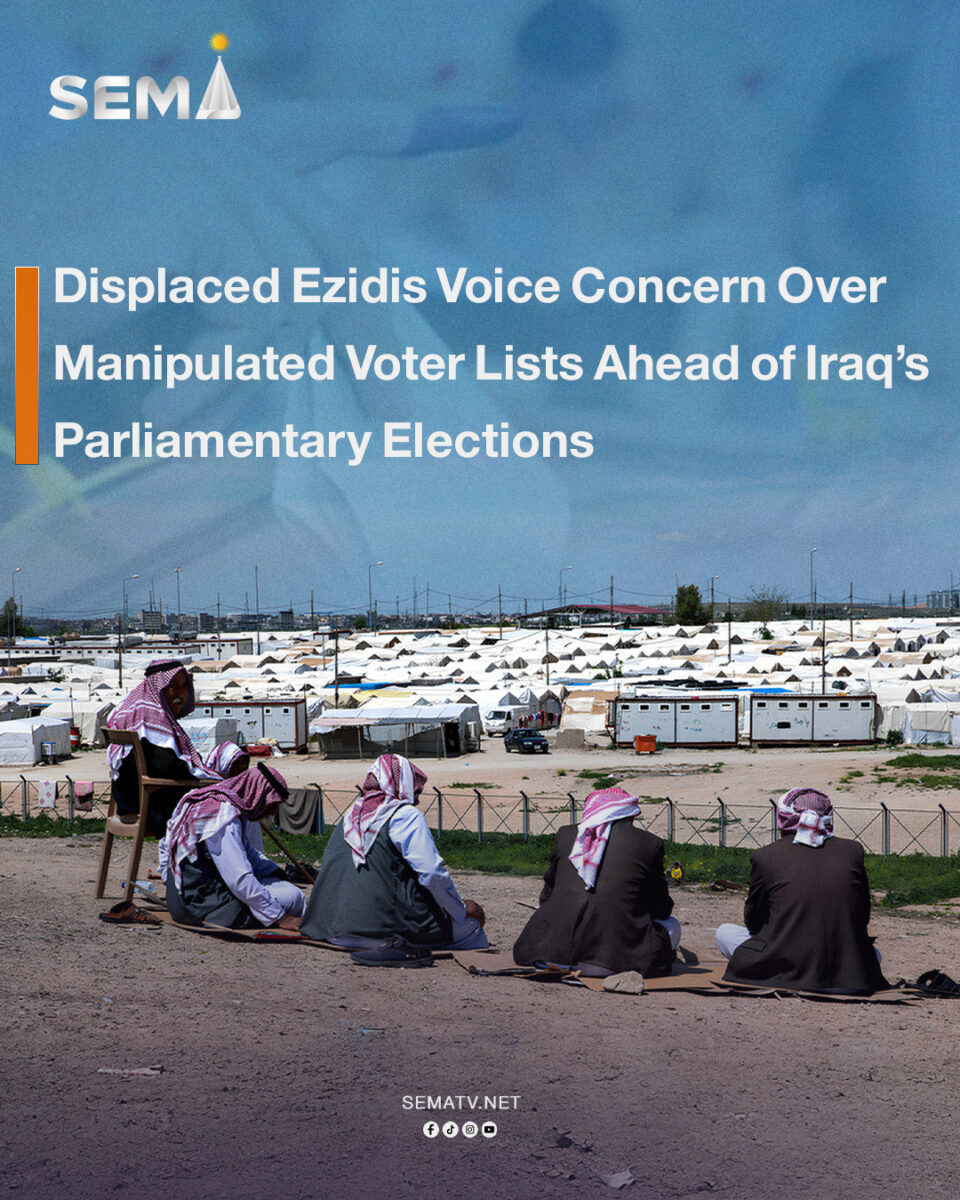
As Iraq prepares for another round of parliamentary elections, displaced residents from Shingal living in Duhok and Zakho camps are expressing growing concern over what they call systematic tampering with voter records and deliberate efforts to deny them their right to vote.
For thousands of Ezidis and other displaced families still living in camps years after the war against the Islamic State (ISIS), this election holds deep significance—it is not just a political exercise, but a chance to restore representation and justice after years of displacement and neglect. Yet many now fear their voices will once again be silenced through bureaucratic manipulation and political interference.
Displaced residents from Shingal say they have identified serious discrepancies in voter registries compiled by Iraq’s Ministry of Migration and Displacement.
“Sheikh Husen,” one of the displaced residents, expressed frustration with the Ministry’s handling of the process. “Members of the same family are registered in different areas,” he said, explaining that while some names appear twice, others are missing altogether. “These aren’t simple mistakes—they’re deliberate manipulations meant to confuse us and block our participation,” he added angrily.
According to official figures, around 31,000 displaced people from Shingal are currently living across 14 camps, with about 26,000 eligible to vote. Roughly three-quarters of them are based in Duhok province, and the rest live in areas near Zakho’s self-administration zones. To facilitate their participation, 22 election centers and 98 polling stations have been set up inside the camps.
Despite these preparations, many displaced families worry that administrative hurdles will prevent them from exercising their right to vote.
Viyan Dakhil, the Kurdistan Democratic Party (KDP) candidate for Shingal and a long-time defender of Ezidi rights, voiced serious concern over what she described as attempts by Baghdad to marginalize Shingal’s population.
“The Iraqi government and the Ministry of Migration and Displacement are trying to silence Shingal’s voice,” Dakhil told that. “This is unacceptable,” she said, insisting that all displaced people—especially those whose names have not been properly registered in Shingal—must be granted the right to vote.
Dakhil called for electing genuine representatives who would stand up for Shingal’s people in parliament. “Our community needs leaders who will defend their rights, not allow others to use them as political pawns,” she emphasized.
In response to these growing complaints, Hogir Casim, deputy head of the Duhok office of Iraq’s Independent High Electoral Commission, told that the Commission has already shared the relevant data with Baghdad and is in ongoing coordination with the Ministry of Migration and Displacement to fix cases of duplication and omission.
“We are in constant communication with the ministry to address these technical issues,” Casim said, acknowledging the legitimacy of the displaced families’ concerns and promising to follow up on them.
The plight of Shingal’s displaced voters reflects deeper national worries about Iraq’s electoral fairness and inclusivity. These issues were recently highlighted by Fazil Mirani, head of the Kurdistan Democratic Party’s Political Bureau Executive Committee.
Mirani described Iraq as a country with “diminished sovereignty,” governed by a system that structurally sustains inequality among its communities. He pointed out that the multi-constituency electoral law unfairly disadvantages areas like the Kurdistan Region and minority groups such as the Ezidis, while giving disproportionate weight to some southern provinces.
According to Mirani, this setup was intentionally designed to preserve a majoritarian monopoly. “They structured it so that the Shiite majority remains dominant,” he said, explaining that the value of a vote in Duhok or Erbil is far less than that of a vote in the south—an imbalance he described as “a system built on injustice.”
For displaced Ezidis from Shingal, these structural inequalities are not abstract—they shape their daily lives. Many have lived in camps for nearly a decade, stripped of homes, livelihoods, and now, possibly, even their political voice.
“They want us to remain victims, not citizens,” said an Ezidi woman living in a Duhok camp. “If we are denied the right to vote, our suffering will continue without anyone hearing us.”
Her words echo Mirani’s criticism that Iraq’s political system has failed to uphold the principles of partnership, consensus, and balance set out in the constitution. The Ezidis of Shingal—among the most persecuted and least represented communities in Iraq—now stand as a testament to that failure.
As the elections draw near, Shingal’s displaced population sees their participation not only as a constitutional entitlement but also as a test of Iraq’s democratic integrity. “If we are once again denied our vote,” said Sheikh Husen, “then Iraq’s democracy means nothing to us.”
Viyan Dakhil reinforced this call, urging authorities to take swift corrective action. “Every displaced family must have the chance to vote,” she said. “This election must not become another chapter of exclusion for our people.”
With the ballots yet to be cast, it remains to be seen whether Iraq’s institutions will uphold their promise of inclusion—or whether, as Fazil Mirani warned, the cycle of “diminished sovereignty and selective justice” will once again determine the fate of the nation’s most vulnerable citizens.