
Sema
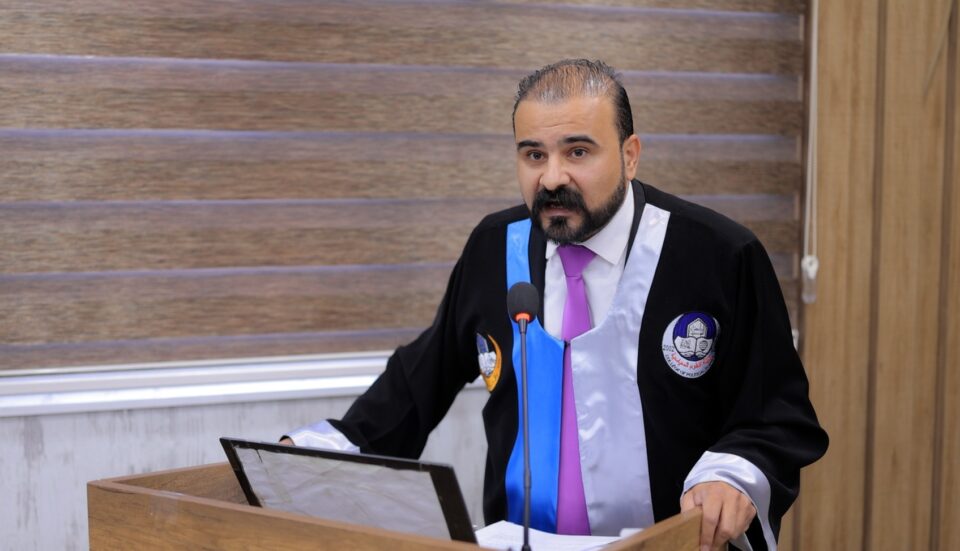
In a story woven with threads of pain and hope, Diyar Naamo, a young man from the Ezidi community, shares his extraordinary journey—from forced displacement and hardship to standing proudly as the top graduate of the College of Political Science at the University of Mosul (Evening Studies) with honors.
“These circumstances deeply affect a person’s life, especially when marked by turning points and drastic changes. Being displaced for years and later engaging in community service taught me one thing: that willpower is the decisive force in achieving one’s goals.”
A Lifelong Passion for History and Politics
From an early age, Diyar showed a clear passion for history and politics—a fact well-known to his family and friends. He tried to enroll in the literary stream during high school, but due to limited options in his area, he was forced to study science instead. Despite his efforts to transfer to a distant school in Tel Kaif to pursue the literary path, it didn’t work out. Though he achieved a good score that qualified him for admission to the College of Nursing, he turned it down, as it didn’t align with his true passion.
A Turning Point in Mosul
After enduring years of displacement and obstacles, Diyar finally earned a spot at the College of Political Science at the University of Mosul (Evening Studies), a turning point that changed everything.
“Becoming the top student was never my initial goal. But as I immersed myself in the theories of peace and war, international relations, and current events, I began to enjoy the process deeply. Eventually, I was told I ranked first in my year—and that success continued throughout my studies.”
His efforts culminated on Thursday, July 10, 2025, when he was honored as the top student of the entire College of Political Science, across both morning and evening programs—a recognition that crowned years of perseverance and commitment.
Political Science: A Vital Need for the Yazidi Community
Diyar emphasizes that the title “Political Researcher” isn’t just academic—it carries with it a mission. His role, as he sees it, involves more than analysis: it includes planning, strategizing, and offering informed advice to decision-makers.
As a survivor of a community that has endured genocide and systemic oppression, he believes the Yazidis desperately need such fields of study—particularly political science, history, and the humanities.” We need to document, to analyze, and to build research centers that produce policy papers for relevant institutions. What we went through cannot be addressed by emotion alone; it requires scientific tools.”
He continues: “Any community that has suffered persecution or atrocities must rely on academic experts in political and historical fields to understand and rebuild. This is our roadmap to the future.”
Diyar Naamo’s story is more than an academic success—it’s a powerful message: willpower and education are the true tools for confronting injustice and building a more just, informed future.